Today marks one year since I arrived home from Zambia. I've been thinking a lot about it lately, so I thought I'd share some of my thoughts with you.
Deciding to leave Zambia was hard. Coming home was the hardest thing I've ever done. A year ago today I was feeling lost, knowing that I needed to come home but feeling like I'd let down everyone I knew by starting this big adventure and then ending it so soon. I decided I wanted to join the Peace Corps six years before I actually left, and it turns out six years of hopes and dreams and expectations are hard to let go of. I wondered how I had managed to think for so long that this was going to be exactly what I wanted to do, only to have it turn out to be something that made me pretty miserable.
A friend from my group made the decision to leave Zambia a few months after I did, and she shared a quote that has really stuck with me. "Respect yourself enough to walk away from anything that no longer serves you, grows you, or makes you happy." I think it's a nice concise way of explaining why I left. Even after all those years of preparation, conversations with RPCVs, discussions in Master's International about expectations, and extensive blog-reading, I found that being a PCV didn't serve me, grow me, or make me happy. And it's taken me a long time to believe it, but that is a good enough reason to leave.
When I came back I spent a few weeks at home, then moved down to southern Georgia. I was lucky enough to be offered a job at the Florida Department of Health a few months later, and I've been working there for about nine months now. I can honestly say I love my job. It's something different every day, I work with great people, and it gives me endless opportunities to educate people about public health and learn a lot of new things. Basically it's everything I never knew I needed. It's too early to know whether I'll want to do this kind of thing long term, but I feel like I learned a lot about myself in Zambia that really helps me clarify what I do and do not want to do with my life and I am so grateful for that.
The hardest thing for me now is explaining to new people that I meet why I left the Peace Corps. I'm afraid that sometimes they come to the conclusion that I left because I didn't like living without running water and electricity, or that they think I don't think the work PCVs do is valuable. I think when most people think of the Peace Corps, they think only about the first goal, which is to help the people of interested countries in meeting their need for trained men and women. They imagine it's about teaching English, empowering women and girls, and educating about HIV. And it absolutely is about all of those things. But that's only goal one of three. The other two goals are to help promote a better understanding of Americans on the part of the peoples served, and to help promote a better understanding of other peoples on the part of Americans. I try to think of those conversations as a continuation of the third goal. Yes, I decided Peace Corps was not a good fit for me. But Zambia is an amazing country full of wonderful people, and I would love to go back someday. And the Peace Corps is a great organization with thousands of amazing volunteers doing great things. I'm lucky to have been one of them for a little while.
As I said a year ago, on to the next adventure!
Sunday, October 4, 2015

Saturday, October 4, 2014
Coming Home
I never thought I would have to say this, but after a lot of thought I've decided to end my service early. After just four months in Zambia, I'm coming back to the US of A. It's a hard decision to make, but I'm confident that it's the right one for me. I found a blog from a guy who ET'd from Peace Corps Panama and he explains it better than I ever could:
"The Peace Corps, when you get down to it, is like any other job – if you don’t like a job, you find a new one... I like to use this analogy: you need to buy a new couch for your apartment. You get on craigslist. You find what you think is the perfect couch (you can only see pictures and read the description). You make all of the measurements and find that the couch is the perfect fit. You can’t pack it in your Toyota Corolla, so you rent a U-Haul truck and get a couple of friends to help you move the couch. You’re all set and SO excited. And then you see the couch. And it’s not what you wanted at all. It’s not what you’d thought it would be. You don’t like how it looks or how it smells. It has a few stains you couldn’t see from the picture. So, the question is, do you buy the couch anyway since you put so much effort into getting it in the first place? Well, that’s up to you. But I decided not to buy the Peace Corps couch."
I am generally a pretty happy person, and I wholeheartedly believe that it's important to do what makes you happy, no matter what that looks like or how hard it is. I have thought for a long time that being a Peace Corps Volunteer would make me happy, but it turned out that I was unhappier than I've ever been. Part of it was normal settling-in type of stress: loneliness, isolation, boredom, and struggles with language. All of that is normal, and for most people it gets more manageable as you integrate into your community. But the real problem for me is something that wasn't going to change as I got settled in. As soon as I moved into my site I started to realize that the job of a health volunteer is really not what I want to be doing. I have known for nearly ten years now that I wanted to be an epidemiologist, and while I knew that that's not what a health volunteer does I thought it would be a good experience, something I could be excited about doing for two years. Instead I found that I didn't like it at all, and it got to the point where I was spending every day just waiting for it to be over, looking at my watch every five minutes, and dreading pretty much everything I was doing. After a lot of tears, frustration, and conversations with other volunteers, family, and my very patient husband I decided it's just not worth it to be so unhappy (and therefore unmotivated, and therefore not particularly helpful for my community) when I could do something about it.
Even though it was my own decision to leave, it was still really hard. It was heartbreaking to say goodbye to my community, even after spending such a short time with them. It was hard to give away my cat, even though I know he'll have a good home with Mr. Chilongo. It's hard to leave without getting to say goodbye to all of my PCV friends, and to know that I won't get to be there with them for IST, hanging out at the prov house, and future vacations and fun times. Most of all it's hard to admit to myself that the thing I have wanted for so long and worked so hard for isn't a good thing for me after all. I feel very fortunate to have had so much support from everyone in Zambia and for the great friends I made during my four months there.
So that's that. As I write this I am sitting in a restaurant in the Detroit airport drinking tap water with ice (yay!) and listening to a bunch of ignorant people talk about ebola (not yay.) I'm excited to be home this afternoon, I'm excited to get to live with Luke two years earlier than expected, I'm excited to have arrived home in time for pumpkin spice lattes. Most of all I'm happy that I had the chance to spend four months in Zambia with the Peace Corps, even if it didn't turn out like I had hoped. On to the next adventure!
Sunday, September 14, 2014
Home Sweet Hut
I moved into my new house a little over a week ago, and since then I've spent a lot of time getting it cleaned, organized, and decorated. Aside from a little flea problem, I really love my house. Now that it's a bit more set up it's starting to feel more like home.

This is the view from the front. The piles of brick are there because there used to be a puppy pen (full of fleas) on the front porch and it was recently demolished.

This is the view from sitting on the front porch. The thing on the left is my dish rack, and the thing on the right is my insaka, which can be used for cooking or chatting with guests or hanging out. Brad (the volunteer before me) left a hammock in there, but it was torn apart by some dogs so you can't sit in it.


To the right of my house you can see my neighbor, Ba Justina's house, and my mango tree. To the left you can see my icimbusu (latrine) and my ulusasa (bathing shelter). Behind the house there is a clothesline.


Next we have the living room, which is nice and sunny during the daytime if I leave the door open. It's even big enough to store my bike inside. I have a couch, a bookshelf, and a chair that I bought from Brad. I hung maps of the world, Zambia, and the U.S. on the wall for decoration. My candle holders are empty beer and wine bottles, but I covered them in chitenge in an effort to make them look more like decorative candle holders and less like I just have empty beer bottles lying around.
Across from the couch you can see my awesome hut warming present from Mom and the space where I'll hang more pictures once I buy some more paper clips. The door on the right with the blue curtain leads to my bedroom and the door on the left is to the kitchen.

My bed takes up most of the space in my bedroom. It has a mosquito net of course, with a sheet over the top of the net to block dust that falls from the ceiling.
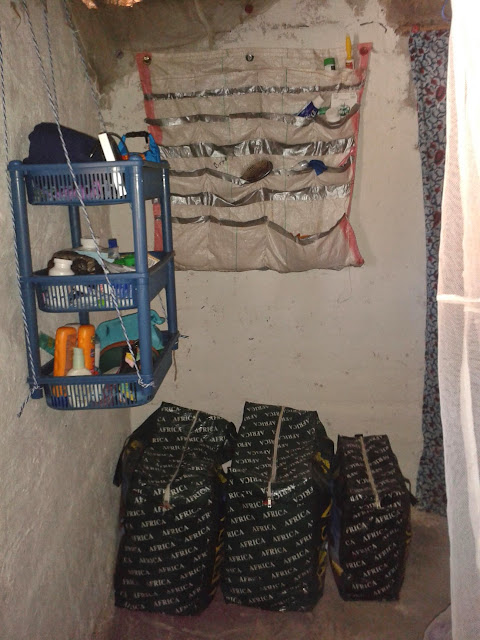

I have a hanging pocket thing where I store some of the things I use every day, and some shelves for other storage. My clothes are currently living in bags, but I went to see the carpenter the other day and he is going to make me a dresser. I also hung up all my shoes on the wall so critters don't climb in them as much, but it's still a good idea to shake them out before you stick your feet in them.

I cook over coals outside so the kitchen is really more of a storage room. I have a table, some shelves for food storage, and a bunch of other stuff that just didn't really fit anywhere else. The yellow containers are how I store my water.

Most of my food is inside of the black plastic bucket at the bottom of the picture, and on the green shelves I have some condiments, tea, canned goods, and cooking utensils.

My table has a nice shelf underneath for storing dishes, and on top I keep my water filter. Above the table I have some hanging baskets for more storage.

I keep my spices on another shelf, and I have a bunch of other things like laundry soap and extra plastic bags stored in bags hanging from the wall.

Last you can see my pots and pans hanging from hooks on a rope. I also hung my empty suitcases up on the wall. Basically anything that can be off the ground should be to keep it safe from critters.
Wednesday, September 10, 2014
Officially a Peace Corps Volunteer!
On August 29th the CHIPs and REDs from my intake had our swearing in ceremony and officially became Peace Corps Volunteers! The swearing in ceremony was at the ambassador's house, which was super fancy and had a pool and a tennis court and a lot of flags and eagles everywhere. There were a lot of speeches, a couple groups did their performances from cultural day, and we took a lot of pictures. It was fun (and weird) to see everyone dressed up and wearing makeup and chitenge outfits and looking fancy. The oath that we take is usually administered by the ambassador, but for us it was some guy named Tim. He has a job title, but I forget what it is. After the ceremony was over we ate probably the best food we've had so far in Zambia, which included chocolate chip cookies and beef that wasn't all chewy and gross. Then we took a million more pictures and that was that. It was a really good day and I enjoyed it a lot but I have to say it was a little anticlimactic. After swearing in we were all rushed off to the mall to shop for being posted, so it was just a really hectic day. On to the next adventure-- moving in to my new home!


Wednesday, September 3, 2014
Cultural Day
One of the final events during PST is cultural day, which is a chance for us to show what we've learned about Zambian culture and share some American culture with our Zambian trainers and homestay families. It went really well and it was a ton of fun. Unfortunately most of my pictures were taken on my real camera and not my phone, so I can't post them until I have wifi, but I'll try to describe everything as best I can.
One of the most exciting parts of cultural day is that the trainees make American food for lunch. Theresa, Beth and I volunteered to help organize the meal preparations, which it turns out is rather challenging when you're planning to feed 120 people. We shopped for food on Monday afternoon and spent Monday evening chopping and preparing with several people, then all morning on Tuesday everyone helped prepare the food and decorate the insaka for the festivities. We made burgers, hot dogs, fried chicken, pasta salad, potato salad, napa cabbage salad, rice, vegetarian chili, grilled cheese, rice krispy treats, and apple cinnamon topping for vanilla ice cream. The cooking part was fun and generally went far better than it could have, especially considering we had only one working burner on the stove, no ovens, and not nearly enough knives and bowls.
We started the ceremony by singing the Zambian national anthem, then ate lunch. There were a couple speeches by the Peace Corps Zambia country director and the health program director, then speeches from one person in each language group. I only understood the Bemba speech, and even that one not all the way, but they were all great. I had to give a speech in Soli thanking the chieftainess, which also went well despite the fact that my Soli ability is limited to reading what was on the paper they gave me. Then each language group did either a song or a dance in their language. They were all really fun to watch. The Bembas sang a song written by one of our language teachers, which if you translated it into English probably sounds a lot like a song you might expect preschoolers to sing. I guess that isn't too surprising since we all speak Bemba at approximately three year old level. After all the local language songs we did an unrehearsed version of the macarena dance because none of us realized we were going to be expected to perform an American song and dance as well. It was a good last minute choice because all of us know it, but I thought it was a little funny that that's the one piece of American culture we presented during cultural day.
The last thing on the agenda was saying goodbye to our host families. We all exchanged gifts with our bamayos and hugged and took lots of pictures, and then they all left and we all went back to the kitchen to finish what was left of the ice cream from lunch. It was a really good day and a great way to spend my last day in Chongwe before we headed off to Lusaka for swearing in.

Saturday, August 9, 2014
Second Site Visit
I just returned from second site visit, where we all got to spend a few days in groups with a current volunteer in our province, then a few days alone at our future sites. I've been looking forward to second site visit for ages now, and it was so great to finally get to see what Northern Province is like, what my future home is like, meet some people in my village, and meet some other volunteers in Northern at the prov house.
For the first part of my second site visit I went to Chikakala, which is in Mpika district. Ginny and I stayed with Genevieve, a health volubteer who is COSing in a few weeks. Ginny is replacing Genevieve, so she got to spend her entire second site visit at her future site. Genevieve's catchment area is really spread out so we rode bikes around a lot to other villages in the area. We went to an under 5 clinic one day, which is where mothers bring their children to get weighed and track their growth progress, get vaccines, and get vitamin A and dewormed. We got to give a talk to some of the mothers about nutrition in Bemba, which was really intimidating at first but it was great practice and it got a lot easier as we went. On a different day we did a village inspection for mosquito nets with the headman and some NHC (neighborhood health committee) members. They had a net distribution about two weeks before we were there, so we went house to house to ask if people had hung their nets yet. If they had, we asked to see so we could make sure they were hung correctly. If they hadn't, we asked if we could help hang it for them. It was a really good way to meet a lot of people and see the village, plus we talked to people at every house about how to care for their nets so I got another chance to practice speaking Bemba. People were very patient with my slow and not-that-confident attempts at Bemba, which I really appreciated.
Aside from getting a taste for what types of things a health volunteer might do, we also spent a lot of time talking to Genevieve's neighbors, playing with her adorable cat Kasha, cooking, and having Bemba classes with ba Lombe in preparation for our big language exam coming up. It's always nice to get out of training for a little while and experience something a little more similar to what our lives will actually be like for the next two years, and I had a really good time.
After five days at Genevieve's site, I headed off to my future site. It's about 20km south of Kasama, the provincial capital. I got to see the house I'll be living in, meet my neighbors, get water from the borehole at the school, and practice cooking for myself on a brazier, and that was just the first day. Each of us has a host in our village to help facilitate our introductions in the community and show us around, and mine is Mr. Lewis Chilongo, the chairperson of the Musa NHC. He's really great and I feel very lucky to have a host who is so well respected and involved in the community. Every day he would stop by a few times just to check in and see how things were going or to take me to meet people. I went with him to meet the headman, the teachers at the school, the clinic workers, and the principal of the farm training institute nearby. I also went to church and introduced myself after the service, so I met a ton of people that way. I watched a soccer game at the field behind the school as well, and that was fun except I couldn't help but cringe every time someone kicked the ball because most of them weren't wearing shoes. Ouch.
I was so so excited to finally see my house and my village, and now I'm even more looking forward to moving there. I can already see some potential challenges in my community, but there are even more opportunities and resources and great people so overall I'm super pleased with everything and anxious to get started. Now only a few weeks of training are left before we swear in and become official volunteers!

Mr. Chilongo and me at the host workshop in Lusaka the week before site visit

My new home!
Friday, July 18, 2014
Site Announcements!
We got our site announcements today! It's been a long week with waiting to find out, especially for the Bembas because we could be placed in three different provinces. They made a big outline of Zambia on the floor with tape and marked each of the available sites on it, and then one by one they called us and told us where we'd be going.
I am going to Musa in Northern Province. It's about 20km from the provincial capital of Kasama. My site is 2.5km from the tarmac, and the nearest volunteer is a RAP volunteer named Mike, and he is 20km away. I'm a second generation volunteer, which means there has been one volunteer there previously and one will be there after me. The PCV who was visiting us this week at PST told me that the volunteer who is at my site now and is finishing up his service was also an MI from Rollins, so that's fun. That's pretty much all I know about it at the moment, but next week I'll get to meet my counterpart from the community for a host workshop and the week after that I get to head up there for second site visit.
Even though I know barely anything about my site, I'm absolutely thrilled with my placement and I can't wait to meet my counterpart and find out more.


Friday, July 4, 2014
Bemblish
I am learning to speak Bemba, which is spoken in Central, Northern, and Luapula provinces in Zambia. My language class is me, Dana, Meghan, Rachel, and Melody. Our LCF (language and cultural facilitator) is ba Mwelwa. He's very patient with all of our slowness and questions, and he laughs a lot. Sometimes at us, but not meanly so it's okay. Our class of five is bigger than most, since most have only three but there are a lot of people learning Bemba so the classes are larger. The Bembas are split into three classes, and there are three people/one class each for Nyanja, Tonga, Tumbuka, Lunda, and Kaonde.
Peace Corps told us language classes are a "fun club" and I didn't quite believe them, but it turns out they weren't totally wrong. It is kind of fun most of the time, but the rest of the time it's incredibly frustrating. I haven't taken a language class in almost six years so my brain is struggling to be in language-learning mode, plus it's four hours of language a day, five days a week. It's a ton of vocabulary and material, plus Bemba isn't really anything like the other languages any of us know so that makes it a bit harder. But it's only been two weeks, and already I can introduce myself and talk about my family, talk about what I am learning at training, say some super basic health things, list some food items, list some household items, name some body parts, and describe a person. So we must not be doing as badly as it feels like we are when we're in class struggling to conjugate verbs.
In Bemba you put "ba" in front of names and some words to show respect. In class one day we were learning words for various professions and people and I put ba in front of the word for baby because it followed the pattern of the other words and it seemed reasonable. Ba Mwelwa laughed and said, "Do we respect babies?" We all were kind of confused, thinking yes, I mean, I think we do, don't we...? Apparently the answer is no, we do not respect babies.
At the beginning of each lesson there are some cultural notes, and after explaining then to us ba Mwelwa usually asks us how it is in America. For the lesson that included describing people, one of the cultural notes was that in Zambia telling someone they are fat is a compliment. It was entertaining to try and explain why the opposite is true at home. I think on the same day we ended up explaining breast implants and plastic surgery to ba Mwelwa as well, which was even funnier.
The words for patient and husband are very similar (abalwele and abalume) so I frequently end up saying things like, "How many malaria husbands do you have?" and, "My patient's name is Lucas." I also tend to get the words for eyes and eggs mixed up even though they are not all that similar (ameenso and amani) so that during the language test we had yesterday I almost asked the instructor to pass me the eyes instead of the eggs.
So my Bemba is coming along, amusing mishaps and all. It's a long process and I'm sure I'll never be as fluent as I'd like to be, but hopefully I'll know enough to get by. And in the meantime I am getting pretty good at sentences in half English/half Bemba, aka Bemblish.
Insoka in the insaka: some stories from PST
I'll start with the story this post is titled after: insoka in the insaka. Insoka is snake in Bemba, and an insaka is a semi-open round structure with a roof and low walls but no doors. Most of the training sessions we have at the training center take place in a big insaka, and on one of the first days we were all sitting there having a session on something when suddenly there was a commotion at the back of the room. People started screaming and running away and it turned out a brownish gray maybe 4 foot long snake had wandered in. Chairs were overturned and bags were scattered as we all ran to the other side of the insaka, and some of the Zambian trainers went outside and grabbed some big rocks and threw them at the snake and killed it. It was all over very quickly, and once the dead snake had been disposed of we all picked up our stuff and went back to the session. Of course given my feelings about snakes I was not too pleased, but I did learn two important things. One is that snakes generally are not aggressive (although apparently mambas are an exception). This one seemed sort of confused by all the commotion, like it just happened to be in the wrong place at the wrong time. The second is that if you see a snake, Zambians are very quick to take care of it for you. I had heard that this was the case from other volunteers and I am relieved to learn that it is quite true.
Most days I bike to language class in the morning, bike home for lunch, bike to the training center for afternoon tech sessions, and then bike home in the evening. I am not a super confident biker, but I'm lucky enough to live pretty close to the training center. My ride is only about 10 minutes, and most of it is on the tarmac. The tarmac was only paved a month ago, so my short ride is even easier than it was for previous training groups. The thing I don't like so much about the bike ride is all the kids I have to pass on my way. The young ones were cute at first because whenever you pass you get a chorus of "How are you! How are you!"s. I usually greet everyone in Bemba, which the kids think is funny. But as they got more used to seeing us every day the kids got bolder and decided they wanted to grab onto our bikes as we pass. I'm not a fan of that because I'm afraid they'll break their fingers by sticking them in the gears, or they'll knock me over into traffic. We were taught how to tell them to go away in our language classes, so one afternoon when they came over to grab my bike I said in my meanest voice, "Iwe! Fuma apa!" They retreated and now they usually just giggle at me from afar. Our newest bike annoyance is the maybe 13 year old boys who shout "Hey sweetie!" when we bike past. Sigh.
Another important thing I have learned recently is the importance of staying hydrated. The water from my filter at home is clean and safe to drink, but it tastes terrible. Kind of like charcoal. It's gross. I usually fill multiple water bottles with the nice water at the training center whenever we're there and it works fine, except for when we're not there from Friday afternoon through Tuesday afternoon. Rather than being a responsible adult and tolerating the gross water, I just didn't drink very much over the weekend and on Monday. I was already slightly dehydrated because I was sick on Saturday, so not drinking enough water for a few days made it way worse. I was super tired and not feeling well at all, plus I was in a terrible mood. I was complaining to Aubrey on Tuesday and she said, "How's your poop?" When I told her it was fine she commented that at least I wasn't losing water that way. I realized I had forgotten to be thankful that I didn't have diarrhea, so I drank a ton of water that afternoon and I felt 1000% better. Apparently all I needed was some water and an attitude adjustment.
Training is going well so far, but it's very busy and tiring. I have pretty decent internet access on my phone, as long as I can keep it charged. Keep an eye out for future blog posts on my host family and learning Bemba.
Friday, June 27, 2014
My host family
I am staying with ba Doris and ba Kefas, and their 10 year old niece Dorinda and their 3 year old granddaughter Yuni. They have a daughter named Joyce who lives in Lusaka, but since she doesn't live here I pretty much just consider Do and Yuni my sisters. Ba Kefas is a bricklayer and he's not home a whole lot, at least while I'm here and awake. Ba Doris speaks Bemba, Nyanja, Tonga, Soli and English. She's very good about helping me practice Bemba. The girls mostly just hang around with a group of kids who live nearby. Do goes to primary school and we usually eat breakfast together.
My room is a separate structure from the house, and from what I've heard it's pretty large compared to where the other trainees in my group are staying. I also have a bed and not just a mattress on the floor like most people have, so I feel pretty lucky. I also have had only a couple spiders and ants and the occasional small lizard in my chimbuzi, which is pretty nice compared to the giant black widow Rachel has in hers. Some people have also had a rat problem in their houses, which I am mostly thankful not to have to deal with, but Jodi had rats in her house and Peace Corps brought her a kitten to fix the issue so I feel like at least if I did have rats there would be a small silver lining.
Usually I have bread and peanut butter and hot tea for breakfast, and sometimes there is also a hard boiled egg or a banana. My bamayo gives me a snack to take to school, which is usually an orange or some popcorn or groundnuts. For lunch and dinner we typically have nshima, which is the staple food in Zambia. In this part of the country it's made from corn, but in other places it's made with cassava. It's basically just finely ground corn added to hot water until it's solid, kind of like grits but harder. We eat it with relish, which are side dishes that are usually cooked vegetables (cabbage, tomatoes, rape, or pumpkin leaves) or protein (eggs, soya, chicken, or beans). A couple of times my bamayo has let me help make the nshima, which is pretty easy until you get to the end and then it requires a lot of effort to stir it. I need to work on my nshima-stirring muscles. On the weekends I usually go with to get water from the borehole, which is about a 10 minute walk away. It makes me feel like a weakling when my 10 year old host sister carries 20L of water on her head like it's nothing and I struggle along with my two 5L containers (not on my head) but I guess I'll get better eventually.
We've talked a lot about school and snow and how you can't see as many stars at night in America as you can in Zambia. My host sisters and neighbors asked me a lot of questions about how people cook, what we eat, how we wash our clothes, etc. They also were really confused by ny kindle and thought a book with a battery was a hilarious concept, and I kind of agree with them. Overall my homestay experience has been really good. My family is really nice and we've had some good conversations about how life is different in America and in Zambia.
Tuesday, June 17, 2014
Fifteen things I learned at first site visit
1. Never go on a long car ride without an ipod and a camera.
2. Nshima is way better when your host mom makes it than when you eat it at the Barn Motel.
3. Whenever someone greets you in Nyanja and you don't understand what they said, just say bwino and then repeat what they said.
4. Babies generally do not like being weighed, but they can be tricked into getting deworming pills and vitamin A drops if their mom tells them it is a sweetie.
5. Cooking on a brazier, doing laundry by hand, getting water from a borehole, and taking bucket baths are more time consuming than doing things the way I am used to, but overall not bad. (Although I'm sure I'll get tired of it soon.)
6. A stick lying on the ground in the chimbuzi looks an awful lot like a snake when you go in there half asleep at night.
7. If you are very lucky, your host dad will take you to see his garden and you will get to taste sugarcane and bring back some oranges and lemons.
8. When you go visit the chief you are supposed to bring a white chicken as a gift, but if you don't have a white chicken cookies from Shoprite are acceptable.
9. People in the U.S. who have dogs train them to come when called, and in Zambia you spend most of your time telling dogs to go away. You also constantly have to tell pigs, goats, and chickens to go away or they will eat your food or sometimes try to come into your house.
10. Eggs don't have to be refrigerated in Zambia. Apparently they only have to be refrigerated in the U.S. because they are pressure washed and it removes some membrane. Here they last up to a month at room temperature.
11. There are at least 101 ways to use a chitenge.
12. When you play the "I'm going to the chimbuzi and I'm bringing..." ABC game with health volunteers, people bring iodine, sunscreen, and diabetes screening.
13. You can put "Zam" in front of any word and it instantly becomes better. Zamfriends, Zambeef, Zamtired, Zamfries, etc.
14. Peace Corps friends are unlike any other friends. I'm having deep conversations about life and love and bodily functions and everything else with people I only met a week ago, and it's really great.
15. Zambia is absolutely the most beautiful place in the world.
Sunday, June 15, 2014
Finally in Zambia!
I'm finally in Zambia! I left for staging in Philadelphia on the 10th. Staging was part introduction to Peace Corps, part travel logistics and part meet everyone and discuss our expectations and concerns. It was quick, but I really liked it because it was nice to be in a room full of people who all are feeling the same excitement, anticipation, and nervousness. There are 63 people in the group, 33 health and 30 education. We got on buses at 2:30am to drive to New York, waited in a pile on the floor at JFK for a couple hours until we could check in, then went through security and waited some more. The flight to South Africa was 15 hours long and we were all exhausted so it wasn't a ton of fun. Then we just had a quick two hour flight to Lusaka.
Peace Corps picked us up from the airport and took us to the Barn Motel, which is pretty much where we've been since then. We've been doing a lot of paperwork, got a rabies vaccine, picked our malaria prevention, and heard a presentation about safety and security and a couple about how to stay healthy. We also had a session with Ba Beene, the health program manager. She's really great and very funny, and it made us all really excited for what's to come. The Barn Motel is really nice; the electricity works most of the time and there are toilets that usually work. There is hot water for showers most of the time too, and occasionally a lack of cold water so that anyone who tries to take a shower gets scalded. That's kind of the opposite of what we expected to happen since we were told to expect cold showers.
Yesterday we went to Lusaka to go grocery shopping for first site visit and get sim cards and phones. I am going to Eastern province for site visit with Ginny, Meghan, Jodi and Katherine. We're staying with a volunteer named Sue for four days to see what it's like to live in the village and be a health volunteer and such. I'm super excited to finally get out of the sort of closed-in environment of the Barn Motel and experience something more similar to where we'll all eventually be placed for two years. We on our way to site visit now, and it's a six hour drive so we'll get to see lots of scenery on the way.


Wednesday, June 4, 2014
Packing
It's kind of hard to figure out what to bring when you're packing for over two years. Of course even if I forget something super important, I can get it in Zambia or ask someone to ship it to me and I'll have it eventually, but there's still a lot to consider. Peace Corps gave us a packing list, pretty much every Peace Corps blog ever has packing suggestions, and current PCVs and RPCVs have advice. It's all very helpful, but also really overwhelming. I think the hardest part for me is thinking about this in an I'm-moving-to-Zambia kind of way, not just packing for a trip. The most helpful thing for me has been the advice about what people brought that turned out to be utterly useless, the things they're really glad they brought, and the things they left at home that they wish they had brought. A lot of people have conflicting opinions on what is necessary and what isn't, but it seems like duct tape, ziploc bags, water bottles, a good knife, and a raincoat are the essentials. Everything else is whatever.
 |
| Everything I'm bringing in one picture |
 |
| Packing party! Clearly Claire and Max are being very helpful. |
.JPG) |
| All packed up. |
Tuesday, May 27, 2014
Busy busy busy
I thought that after I graduated I would have all sorts of free time to sleep in and do fun things, but it turns out that's not real life. I sort of forgot that all of my friends and family have jobs, which means they're not available to entertain me all day. Darn. I still have tons and tons of stuff to do when I'm not spending time with family and friends, and for the most part it's way more fun than my previous thesis-busyness. Here are some things currently on my never ending to do list.
1. Unpack all of the stuff I brought home.
2. Buy the stuff I don't already own that I need to take to Zambia.
3. Watch a lot of Food Network and HGTV shows.
4. Organize all of the files on my computer and external hard drive.
5. Eat my favorite home-foods and visit my favorite Schaumburg restaurants.
6. Cuddle with my adorable cats.
7. Work on getting my thesis published.
8. Pack and organize everything I own.
9. Go on bike rides.
10. Mentally prepare myself to leave for Zambia in two weeks... eek.
Sunday, May 25, 2014
Goodbyes
Saying goodbye to friends is hard. I graduated from Emory on May 12th. The diploma ceremony ended at around 3:00, and by 6:00 we were on the road back to Chicagoland. It was a very rushed goodbye with all of my Rollins friends, and I missed seeing a lot of people during the hectic running-around/diploma-getting/picture-taking time right after the ceremony. It was not an ideal way to say goodbye to the wonderful people who I spent two very stressful and fun years having potlucks, late nights in GCR, fighting with SAS, drinking tea, and exploring Atlanta with. But thanks to facebook/skype I'll still be able to keep up with everyone to some extent. I'm looking forward to hearing about the impressive things you all accomplish in your public health careers. The day of graduation was also the last time I'll see my awesome parents-in-law before I leave. They came to Atlanta for the weekend, which was great because we got to celebrate Mother's Day in addition to graduation. I am so so lucky to have such a great, supportive family-- even if they all think I'm a little crazy. :)
 |
| Looking disheveled but happy after spending multiple hours outside sweating in our graduation gowns. |
The weekend after graduation I went to Ohio for Brandon and Claire's wedding. I stopped in Bloomington to see Julie on the way there, which was great. On Saturday I had some time to kill before the wedding so I wandered around the union for a bit and ate Cane's. The wedding was lovely and tons of fun, and it was really great to see all the Bradley people again. On Sunday morning we had brunch at Hang Over Easy, and I parked a ways away on purpose so that I would have to walk through campus to get there. It's really weird to be back at Ohio State; I feel like nothing has changed and I could be on my way to lab or to an HvZ or Camp Kesem meeting, but I also feel like everything is different and I don't belong there anymore. As I was driving away after brunch "Road Outside Columbus" came up on shuffle and it made me extra super nostalgic and sad. It's a good song no matter what, but it was rough to hear when I was actually on a road outside Columbus, Ohio after saying goodbye to a place and people I love so much.
 |
| That High Street never looked so good. |
Memorial Day weekend was Grace's graduation party/my going away party, and I got to see a lot of family I haven't seen very often lately, so that was nice. I said goodbye to a lot of aunts, uncles, cousins, and neighbors and explained at least ten times what it is I'll be up to in Zambia. It's kind of interesting to hear what other people's questions and concerns are about me leaving because occasionally it brings up things I haven't thought to worry about yet. I'll just add them to the long list of things I have to be nervous about. Luckily the list of things I'm excited about is way longer. :)
 |
| The adorable Ohio State/Peace Corps cake |
Friday, May 9, 2014
One Month
I just got the staging email that I've been waiting forever for! I'm leaving for Philadelphia in one month, bright and early in the morning on June 10th. Staging stuff happens the afternoon and evening of the 10th and then we get on a bus to JFK at 2am for our flight the morning of the 11th.
It's hard to believe I'm leaving in one month. I've been waiting for this for six years, since I went to a study abroad fair at OSU freshman year. I had been thinking about the Peace Corps even then, but I didn't think there would ever be a time when I could take two years off from school and work to do it. But the person at the Peace Corps table at the study abroad fair told me about Master's International, and ever since then that's been what I've been working towards. The more I learned about PC the more I realized my fear that I'd be unable to take two years off from school and careers was sort of silly, but I'm still really happy with the decision to do MI.
Ever since I got my invitation, people have been asking me if I'm excited. Of course I was, but I kept saying yes, but mostly I just want to finish my classes and my thesis and then I can put more energy into being excited. So now that all my school stuff is over, it's time for FULL TIME EXCITEMENT MODE! Packing, moving, seeing family and friends, more packing, visiting Luke, hanging out with my cats, stressing about packing, Brandon and Claire's wedding, packing stress again, trying to get three papers ready for publication, and more packing. Hooray!
Friday, April 25, 2014
World Malaria Day!
It's World Malaria Day, and I have been looking forward to today for months. Part of that is because I am a big nerd, but it's also because a lot of really cool things are happening today/this week.
Most importantly, I finished my thesis! It is approved and submitted and finished and I am oh so happy. It's called "Factors associated with physical condition of insecticide treated bed nets in Senegal," and it was extra exciting for me because the dataset came from a PCV in Senegal. She conducted a series of bed net care and repair events and did a survey on how people care for their nets, and then counted how many holes there were in the nets. I was going to post the abstract here but then I remembered that I restricted access to it online for two years so I guess I won't. Instead here's a word cloud.
 This morning I listened to a Google+ hangout where PCVs and their counterparts talked about the malaria projects they're working on. It was really neat to hear about all the different things they're doing and some thoughts on challenges with getting their projects going and sustainability after they leave. There's a lot of variety and creativity in the malaria prevention projects happening, and it's pretty exciting to think that someday I might get to be part of that. Then this afternoon I went to the MI/ClaRC end of year celebration, which was a great chance to get to see everyone and celebrate an awesome two years with a lot of really great people. I'm so thankful that I got to be a part of this group; I think it's one of the things that really made my experience at Rollins memorable. It's been fantastic to have so many RPCV friends supporting me through my application process, giving me packing tips, being excited with me, and sharing stories about what Peace Corps is like.
Tonight is second year send off, then only three final projects and one final stand between me and graduation/never having to go to school again ever. (Probably.)
Most importantly, I finished my thesis! It is approved and submitted and finished and I am oh so happy. It's called "Factors associated with physical condition of insecticide treated bed nets in Senegal," and it was extra exciting for me because the dataset came from a PCV in Senegal. She conducted a series of bed net care and repair events and did a survey on how people care for their nets, and then counted how many holes there were in the nets. I was going to post the abstract here but then I remembered that I restricted access to it online for two years so I guess I won't. Instead here's a word cloud.
Tonight is second year send off, then only three final projects and one final stand between me and graduation/never having to go to school again ever. (Probably.)
Thursday, April 10, 2014
A bit more about what I'll be doing
I'm leaving in two months! It doesn't quite feel real yet because I have sooooo much to do between now and then. My thesis is due on April 21st, the last of my finals are on May 5th, and I'm graduating on May 12th. I am super excited to finally be done with school so I can focus on seeing family and friends, packing, and preparing.
Until then, here's a bit more information about what I'll be up to in Zambia. This is one of the most frequent questions I get from friends and family, and the real answer is that I don't know exactly. The following was copied directly from the volunteer assignment description they sent to me with my invitation, but keep in mind that everyone's experience is different. I won't know what exactly I'll be doing until I'm actually doing it, but this is a nice little overview.
YOUR PRIMARY DUTIES
The purpose of your assignment is to work with rural Zambians to improve their health and to empower them to promote appropriate and sustainable strategies that mitigate the effects of HIV/AIDS and Malaria and improve maternal, neonatal and child health. The health project will mandate you to work primarily at the community level.
You will work with your neighbors and friends to help them improve their own and their families’ wellbeing by adopting appropriate and sustainable health behaviors. For example, you may co-train a group of women on the importance of using mosquito nets, how to grow and prepare nutritious meals for their family, or how to adopt healthy child feeding practices and processes for children under five.
You will work with community based organizations to enhance their capacity to improve the health of individuals, families, and communities. For example, you may co-facilitate a neighborhood health committee's planning process to organize voluntary counseling and testing in your community, or you may co-train staff at your rural health center on monitoring and reporting on children's health at the under-five clinics.
It is very important to note that curative health service is NOT an element of this project. PLEASE NOTE THAT PCVs DO NOT DO DIRECT PATIENT CARE BUT INSTEAD THE FOCUS IS ON CAPACITY BUILDING AND SKILLS TRANSFER.
To adequately equip you for your work, you will undergo eleven weeks of intensive training in a local language, technical knowledge and skills and cross-cultural awareness. A certain proficiency in all aspects of training is required before swearing in as a Volunteer. Failure to pass the training requirements may result in disqualification from service and your return to the U.S.
In addition to motivation (which you already have!) and knowledge gained from pre-service training you will also need tons of patience and flexibility. Health behaviors take a long time to change and will not be completely affected or internalized in 2 years. This means that during your service you may not see significant tangible/observable results from your work. Sites generally have three generations of PCVs, so you may be building on the work of your predecessors. Keeping a long term perspective and having the ability to be self-motivated without tangible results is imperative to your satisfaction and success. Many Volunteers find that a combination of humility and selflessness help them cope with the intangible characteristics of their work. It is with this in mind that we expect a great deal of flexibility, creativity, motivation and patience on the part of the Volunteer. The work you will be doing is tremendously important and significant, but like the planting of an acorn, you will probably not see a big leafy oak tree by the end of your service. This is why skills transfer to a local person is vital to ensure the continuation of health education for behavior change.
Until then, here's a bit more information about what I'll be up to in Zambia. This is one of the most frequent questions I get from friends and family, and the real answer is that I don't know exactly. The following was copied directly from the volunteer assignment description they sent to me with my invitation, but keep in mind that everyone's experience is different. I won't know what exactly I'll be doing until I'm actually doing it, but this is a nice little overview.
YOUR PRIMARY DUTIES
The purpose of your assignment is to work with rural Zambians to improve their health and to empower them to promote appropriate and sustainable strategies that mitigate the effects of HIV/AIDS and Malaria and improve maternal, neonatal and child health. The health project will mandate you to work primarily at the community level.
You will work with your neighbors and friends to help them improve their own and their families’ wellbeing by adopting appropriate and sustainable health behaviors. For example, you may co-train a group of women on the importance of using mosquito nets, how to grow and prepare nutritious meals for their family, or how to adopt healthy child feeding practices and processes for children under five.
You will work with community based organizations to enhance their capacity to improve the health of individuals, families, and communities. For example, you may co-facilitate a neighborhood health committee's planning process to organize voluntary counseling and testing in your community, or you may co-train staff at your rural health center on monitoring and reporting on children's health at the under-five clinics.
It is very important to note that curative health service is NOT an element of this project. PLEASE NOTE THAT PCVs DO NOT DO DIRECT PATIENT CARE BUT INSTEAD THE FOCUS IS ON CAPACITY BUILDING AND SKILLS TRANSFER.
To adequately equip you for your work, you will undergo eleven weeks of intensive training in a local language, technical knowledge and skills and cross-cultural awareness. A certain proficiency in all aspects of training is required before swearing in as a Volunteer. Failure to pass the training requirements may result in disqualification from service and your return to the U.S.
In addition to motivation (which you already have!) and knowledge gained from pre-service training you will also need tons of patience and flexibility. Health behaviors take a long time to change and will not be completely affected or internalized in 2 years. This means that during your service you may not see significant tangible/observable results from your work. Sites generally have three generations of PCVs, so you may be building on the work of your predecessors. Keeping a long term perspective and having the ability to be self-motivated without tangible results is imperative to your satisfaction and success. Many Volunteers find that a combination of humility and selflessness help them cope with the intangible characteristics of their work. It is with this in mind that we expect a great deal of flexibility, creativity, motivation and patience on the part of the Volunteer. The work you will be doing is tremendously important and significant, but like the planting of an acorn, you will probably not see a big leafy oak tree by the end of your service. This is why skills transfer to a local person is vital to ensure the continuation of health education for behavior change.
As you will be working at community level and on health issues a GREAT DEAL OF CULTURAL SENSITIVITY IS VITAL! Most health practices that the project aims to improve flow from deep-rooted cultural perceptions and beliefs. You are expected to have advanced communication and interpersonal skills, a deep respect for Zambians, and deferential curiosity for the cultural norms of your community.
During the course of your service you will submit quarterly reports to the Project Manager and a summary copy to your district Supervisor—the District Medical Officer (DMO). This will help Peace Corps assess that our project is on track, measure its long term impact, and provide you with follow up and support.
All PCVs in Zambia are expected to attain and practice the following core competencies: commitment to professionalism and personal well being, the facilitation of sustainable community development, integration of HIV/AIDS Prevention into service, promotion of sustainable practices for food security and integration into the community. The most successful PCVs are those who apply these core competencies daily, especially striving to integrate into their community. Continuous language learning, cultural exploration and a deep respect for Zambians are crucial to community integration and your successful service.
Thursday, March 27, 2014
Zambia FAQ
Some fun facts about Zambia, with comparisons to the US for reference
Capital: Lusaka
Population: 14.3 million (12.9 million in Illinois)
Area: 290,587 square miles, slightly larger than the state of Texas
GDP per capita: $1,721 ($54,609 in the US)
Bordering countries: Tanzania, Malawi, Mozambique, Zimbabwe, Botswana, Namibia, Angola, and the Democratic Republic of the Congo
Language: the official language is English, but there are 73 languages spoken in Zambia. There are maybe 5 or 6 that PCVs learn, depending on where in the country they'll eventually end up. I won't know what language I'm going to be learning until I get there.
Independence: October 24, 1964 from the UK
Religion: 67.8% Protestant, 21.0% Catholic, 8.7% other Christian, 2.5% other or non-religious
Gini coefficient: 0.575 (0.486 in the US)

location of Zambia in sub-Saharan Africa

map of Zambia
Some health stats about Zambia, compared to the U.S. for reference
Life expectancy at birth: 55 (79 in the US)
HIV prevalence per 100,000: 7,204 (419 in the US)
Malaria incidence per 100,000: 25,242 (none in the US since 1951)
Under five mortality rate per 1,000 live births: 83 (8 in the US)
Percent of adult males with raised blood glucose: 7.2 (12.6 in the US)
Percent of adult males who are obese: 1.2 (30.2 in the US)
Sources:
Saturday, March 1, 2014
100 Days!
Today marks 100 days until I leave for staging, so I thought it might be an appropriate time to write a blog post. Also this past week was Peace Corps Week, so there were all sorts of events and things. I went to a happy hour with RPCVs from Emory, CDC, and around Atlanta. I met an RPCV who served in Mongolia and she said sometimes it got down to -30 at night, so I'm glad I'm going somewhere warm.
I've been meaning to write posts with more information about Zambia, my job description, Peace Corps in general, things like that. But, thesis... and classes... and work... so maybe over spring break. In the meantime, here's a couple posts from other Peace Corps volunteers that I thought were great.
Ten common misconceptions about Peace Corps
The real Peace Corps
A couple other important things: This wikipedia article says there are otters in Zambia (and unfortunately a lot of snakes). And here's a video of what one volunteer's house in Zambia looks like.
I've been meaning to write posts with more information about Zambia, my job description, Peace Corps in general, things like that. But, thesis... and classes... and work... so maybe over spring break. In the meantime, here's a couple posts from other Peace Corps volunteers that I thought were great.
Ten common misconceptions about Peace Corps
The real Peace Corps
A couple other important things: This wikipedia article says there are otters in Zambia (and unfortunately a lot of snakes). And here's a video of what one volunteer's house in Zambia looks like.
Subscribe to:
Posts (Atom)